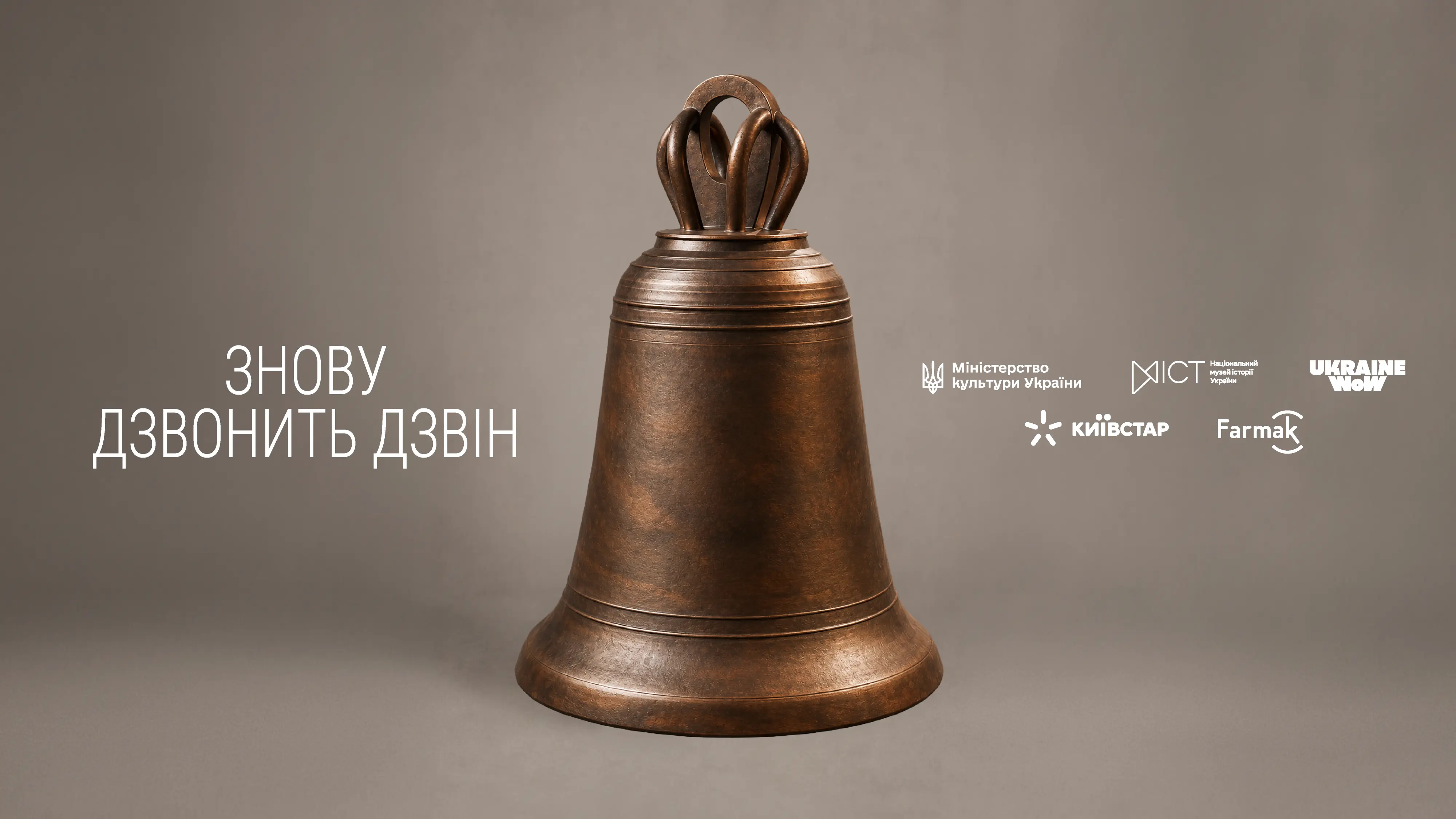

Among the remarkable achievements of Ukrainian researchers, scientists, and engineers working in collaboration with their European colleagues is the recreation of the bell of the Church of the Tithes. Researchers from Igor Sikorsky Kyiv Polytechnic Institute also took part in this project, specifically at a key stage of this international initiative: Serhii Naida, Dean of the Faculty of Electronics, and Mykyta Naida, Assistant Lecturer at the Department of Acoustic and Multimedia Electronic Systems.
International Project
A Glimpse into History. From 3 to 30 September, visitors to the area outside the National Museum of the History of Ukraine could see and hear the reconstructed bell of the Church of the Tithes. It was recreated by members of the Ukraine WOW public organization in cooperation with the National Museum of the History of Ukraine, with support from the Ministry of Culture of Ukraine. Researchers from Ukraine, the Netherlands, Germany, and Portugal worked together to bring the idea of reconstructing the bell to life. It was cast at one of the world’s oldest foundries, Royal Eijsbouts in the Netherlands. The project received no government funding and was made possible through charitable contributions from Kyivstar and Farmak.
Thus, on the eve of the 35th anniversary of Ukraine’s independence, a project was completed that commemorates not only a significant historical event but also the remarkable recreation of the bell of the Church of the Tithes. The original bell was lost in 1240 during the Mongol invasion of Kyiv. A fragment of it was discovered in 1937 by a team of archaeologists led by Teodosii Movchanivskyi (1899–1938). Only 60% of the bell’s surface had survived, while its clapper and mounting had been lost.
“In the spring of 2026, we saw a fragment of the bell in the collection of the National Museum of the History of Ukraine. As we learned more about its history, we realized that we were looking at a genuine relic — evidence of the continuity of Ukrainian statehood. We decided to recreate the bell as faithfully as possible, reproducing not only its shape but also its sound. Specialists from Ukraine, the Netherlands, Germany, and Portugal brought together their knowledge, technologies, and experience to accomplish this task. Now, we can not only see what the bell of the Church of the Tithes looked like, but also hear how it sounded — for the first time in hundreds of years. We are deeply grateful to our partners, Kyivstar and Farmak, whose support made this reconstruction possible,” Ukraine WOW co-founders Yaroslava Hres and Yuliia Solovei emphasized in comments to Ukrainian media.
Since specialists from Igor Sikorsky Kyiv Polytechnic Institute also took part in the project, the editorial team of KP contacted Serhii Anatoliiovych Naida to ask about the university’s contribution. Knowledge and expertise in Ukrainian history, archaeology, materials science, acoustic modelling, and other fields all came together in the service of this worthwhile endeavour.
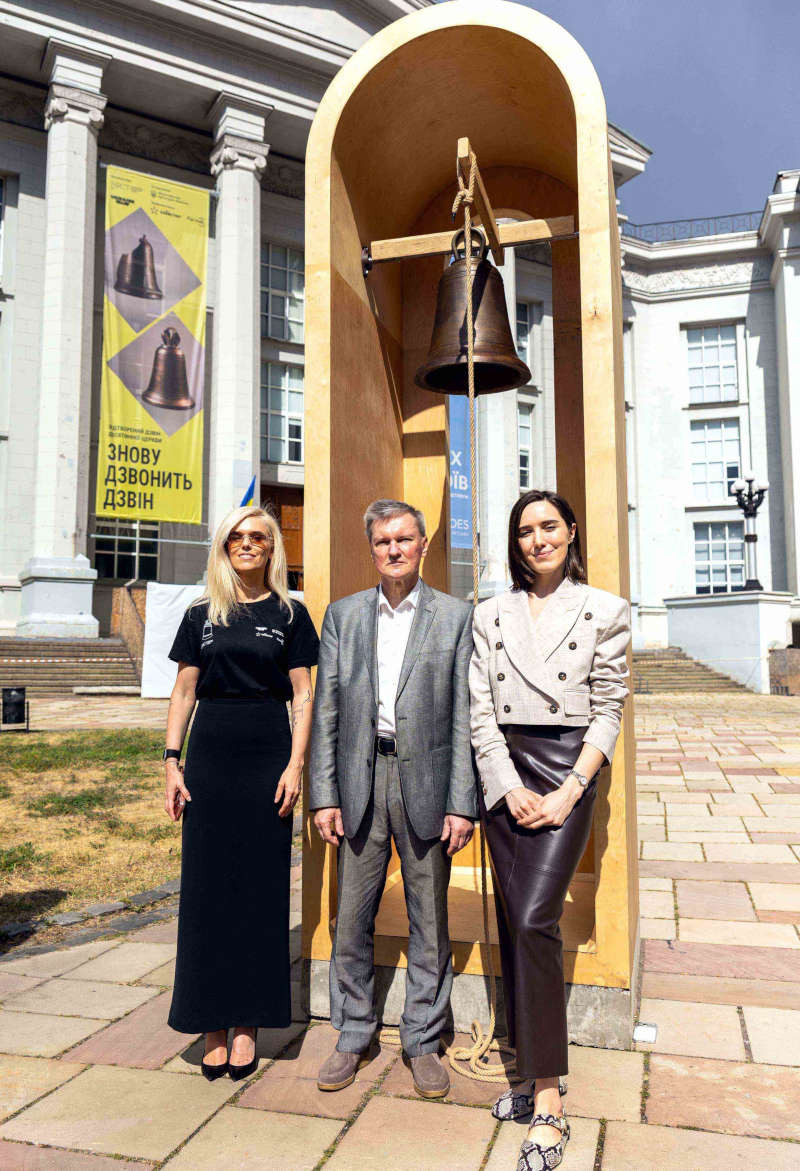 In the photo: Ya. Gres, S. Naida and Yu. Solovei
How the Bell Regained Its Voice
It all began with meticulous calculations. Serhii Anatoliiovych explained: “We used scanning to capture every detail of the artefact’s surface without risking damage to the original. Our colleagues then determined the chemical composition of the bronze using X-ray fluorescence analysis. Next, we created a complete digital model of the bell, reconstructing its missing parts — the clapper and crown — based on the geometry of the surviving fragment and historical analogues. Mykyta and I were responsible for the calculations and computer modelling. We managed to calculate how the metal would behave when struck by the bell’s clapper and then modelled the propagation of sound waves. Acoustic synthesis allowed us to hear how the reconstructed bell would sound long before the bronze casting began. This also enabled us to verify and refine the dimensions and geometric shape of the future model. Digital restoration, computer modelling, and acoustic reproduction of the bell are the areas of expertise we contributed to this international project.” It is worth emphasizing that Serhii and Mykyta Naida mathematically calculated the voice of the bronze bell and heard it before it was cast in metal! Their calculations enabled engineers and foundry specialists at the Royal Eijsbouts foundry in the Netherlands to create this unique artefact, weighing 87.5 kilograms, exactly as envisioned. Thanks to their work, Ukrainians have regained not merely the voice of a bell, but the sound that people heard in medieval Kyiv!
Thus, the bell of the Church of the Tithes itself has borne witness to the successful work of the renowned scientific school led by Serhii Anatoliiovych Naida, laureate of the State Prize of Ukraine in Science and Technology and Doctor of Technical Sciences, Professor, together with his colleagues in a multidisciplinary team of scientists, researchers, and engineers.
The project also involved German expert Klaus Hammer, a specialist in bell manufacturing and Scientific Director of the Bell Museum at the Collegiate Church in Herrenberg, a town in Baden-Württemberg, about 30 kilometres from Stuttgart (editor’s note). Hammer advised the team of researchers and engineers on the design and characteristics of medieval bells and provided historical drawings.
Through collaboration with the Westphalian Bell Museum (Westfälisches Glockenmuseum) in Gescher, Germany, the team obtained research materials on the construction of bell clappers from the 9th to the 13th centuries. At the GlockenStadtMuseum in Apolda, Thuringia, Germany (editor’s note), the project team carried out 3D scans of 13th- and 14th-century bell clappers that have survived to the present day. Another important element in the reconstruction was a fragment of the crown of an ancient Kyivan Rus bell from Sakhnivka, Cherkasy region, held at the National Museum of the History of Ukraine.
 In the photo: M. Naida and S. Naida
The final stage of the project was casting the bell at Royal Eijsbouts in the Netherlands, one of the world’s leading bell foundries. The foundry has cast bells for numerous historic churches across Europe, including the renowned Notre-Dame Cathedral in Paris.
A Phone Call to Professor Serhii Naida
As mentioned above, the project’s sponsors included Kyivstar and Farmak. According to Ukrainian media reports, Farmak also funded the creation of 20 miniature bronze replicas of the artefact, which were donated to Ukrainian schools so that children, too, could learn about this story. Kyivstar, together with the Homin Choir, created an exclusive caller tune based on one of Ukraine’s most beautiful songs, “What a Moonlit Night” ( “Nich Yaka Misiachna”). From now on, every Kyivstar subscriber can hear the voice of the reconstructed Church of the Tithes bell, as its sound is blended with the voices of the Ukrainian choir in the tune. Incidentally, when a KP correspondent called Serhii Naida, the familiar melody, known to Ukrainians across the country, accompanied by the sound of the legendary bell, could be heard on the phone.
The outstanding work of researchers from the Faculty of Electronics at Igor Sikorsky Kyiv Polytechnic Institute, in collaboration with a team of international scholars, is impressive — and not just because of the gleaming surface of the metal from which the bell was cast. It clearly demonstrates that acoustics is much more than simply working with sound: it is a powerful tool for preserving our history. It can also serve as a kind of guidepost for secondary school students who study the fundamentals of physics in depth, inspiring them to pursue their education at Igor Sikorsky Kyiv Polytechnic Institute.
Project Team:
Maryna Strelnyk – Head of the Department of Ancient and Medieval History of Ukraine at the National Museum of the History of Ukraine; Lesia Didukh – Head of the Medieval History Section at the National Museum of the History of Ukraine; Yuliia Bezkorovaina – Head of the Medieval Archaeology Section at the National Museum of the History of Ukraine; Yurii But – Head of the Museum Objects Scientific Restoration Department at the National Museum of the History of Ukraine; Serhii Naida – Doctor of Technical Sciences, Professor, Dean of the Faculty of Electronics at Igor Sikorsky Kyiv Polytechnic Institute; Mykyta Naida – PhD, Assistant Lecturer at the Department of Acoustic and Multimedia Electronic Systems at Igor Sikorsky Kyiv Polytechnic Institute; the team from Royal Eijsbouts, the world’s largest foundry producing bells for towers and clock towers (the Netherlands): Miguel Carvalho (Portugal) – co-author of the research paper “The Sound of Bronze,” one of the key works in the field of digital reconstruction of historic bells, and campanologist at Royal Eijsbouts, responsible for the physical, musical, and historical aspects of bells; Joop van Brussel – Managing Director of Royal Eijsbouts, with 42 years of experience working with bells.
Project Consultants:
Klaus Hammer (Germany) – PhD, bell expert and Scientific Director of the Bell Museum at the Collegiate Church in Herrenberg; Bohdan Kindratiuk – Director of the Bell-Ringing Research Centre, Doctor of Arts, Professor at Vasyl Stefanyk Carpathian National University, and author of the monograph “Bell-Ringing Culture of Ukraine”; Heorhii Chernenko – Honoured Artist of Ukraine, Professor at the National Music Academy of Ukraine and the Luhansk State Academy of Culture and Arts, member of the European Bell Association, founder of the Kyiv Bell Ringers ensemble, and author of the first carillon projects in the Orthodox world, featuring chromatic bell installations at the St. Michael’s, St. Sophia’s, and other bell towers in Kyiv, as well as in other Ukrainian cities.
To mark the 35th anniversary of Ukraine’s independence, a unique event took place: the reconstruction of a bell from the Tithe Church, which was lost in 1240. A key stage of this international project — acoustic modelling — was carried out by specialists from our faculty and the Department of Acoustic and Multimedia Electronic Systems.
The starting point for the reconstruction was the only surviving fragment of the bell, approximately 60% of its surface, discovered by archaeologists in 1937.
What engineering contribution did the team led by Serhii Naida, Dean of the Faculty of Electronics, with the participation of Mykyta Naida, Assistant Professor of the Department of Acoustic and Multimedia Electronic Systems, make to the project?
🔹 The bell’s geometry was fully digitally reconstructed.
🔹 The physical behaviour of the metal during impact was modelled.
🔹 Acoustic synthesis was performed. In effect, the sound of the bell was calculated mathematically and heard before the bell itself was recreated in metal.Based on these calculations, an exact physical replica weighing 87.5 kg was cast at the Royal Eijsbouts Bell Foundry in the Netherlands.
Thanks to this work, we have recovered not simply the sound of a bell, but the sound once heard by people in medieval Kyiv.
A remarkable achievement by our colleagues, demonstrating that acoustics is much more than simply working with sound. It is a powerful tool for preserving our history.