

More than 30 years ago, the Hryhorii Synytsia Art Gallery was opened at Igor Sikorsky Kyiv Polytechnic Institute. Today, his paintings adorn the foyer of the university’s Centre for Culture and Arts. In reality, however, they do far more than decorate the space. They speak, ask questions, and address us with the voices of our ancestors as we hurry past in the bustle of everyday life. Their creator—monumental artist, Boychukist, member of the Sixtiers generation, mentor, and teacher of a distinguished cohort of Ukrainian artists, Hryhorii Ivanovych Synytsia—through his talent and his entire life, embodied a profound love for and devotion to Ukraine’s national identity, its people, and its cultural heritage.
Destiny. Much has been written about the artist’s difficult path and the suppression of his work during the Soviet era. He lived through revolution, wars, and famines. Although he never received a formal diploma in art, he became a widely respected artist. He narrowly escaped execution at Babyn Yar during the Nazi occupation. For his contribution to the post-war reconstruction of Khreshchatyk—where buildings were decorated with ceramic tiles featuring his designs—and to the restoration of the Mariinskyi Palace, where he developed a special clay composition that made it possible to recreate the palace’s lost Baroque vases, he was nominated for the Stalin Prize. However, without any explanation, the nomination was later withdrawn. During his lifetime, Synytsia witnessed the collapse of the Russian Empire, the rise and fall of the Soviet system, and the emergence of an independent Ukraine. Only in the 1990s did he finally receive the recognition he deserved. His works were presented in major solo exhibitions at some of the country’s leading galleries, including an exhibition at Kyiv Polytechnic Institute in 1988, and were met with widespread critical acclaim. In 1992, he received Ukraine’s highest artistic distinction—the Taras Shevchenko State Prize (now the Taras Shevchenko National Prize of Ukraine)—for his outstanding contribution to the revival of the Ukrainian national school of colour in monumental painting and for his series Ukraine Is My Life.
Few people know that Kyiv Polytechnic Institute played an important role in securing this prestigious award. The Institute’s Academic Council, together with art historian and Synytsia’s close associate Hryhorii Miestechkin, actively supported his nomination. At the age of 85, Hryhorii Synytsia was admitted to the National Union of Artists of Ukraine without even having to submit an application. A year later, he was awarded the honorary title of Honoured Artist of Ukraine.
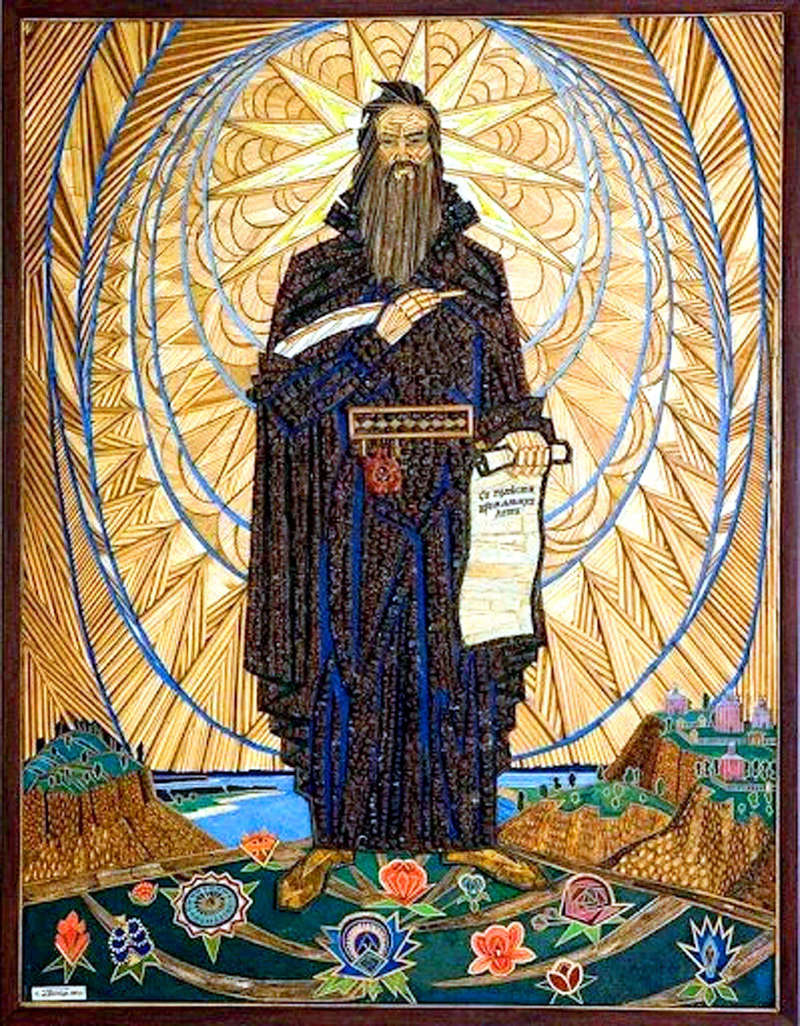 In the photo: Nestor the Chronicler, 1970.
Symbolism. Remarkably, paintings created more than half a century ago still feel strikingly relevant today. One such work is Nestor the Chronicler. The monumental figure of the chronicler stands against the blue waters of the Slavutych River. In his right hand, held at chest level, he carries a quill; in his left, a parchment bearing written text. He stands atop a hill covered with unusual flowers. His long robe, composed of dark-brown chestnut forms set against a blue background, radiates a distinctive visual rhythm. Around his head is a halo of light, while his entire figure seems to emanate warmth, dignity, and spiritual strength. To his right stretch the fertile slopes of Ukrainian land; to his left rise church domes. These are the ancient Ukrainian lands that an insatiable neighbour now seeks to seize, while the majestic chronicler symbolizes a people who have never been conquerors but have instead devoted themselves to cultivating their land, preserving their culture, and nurturing their spiritual heritage.
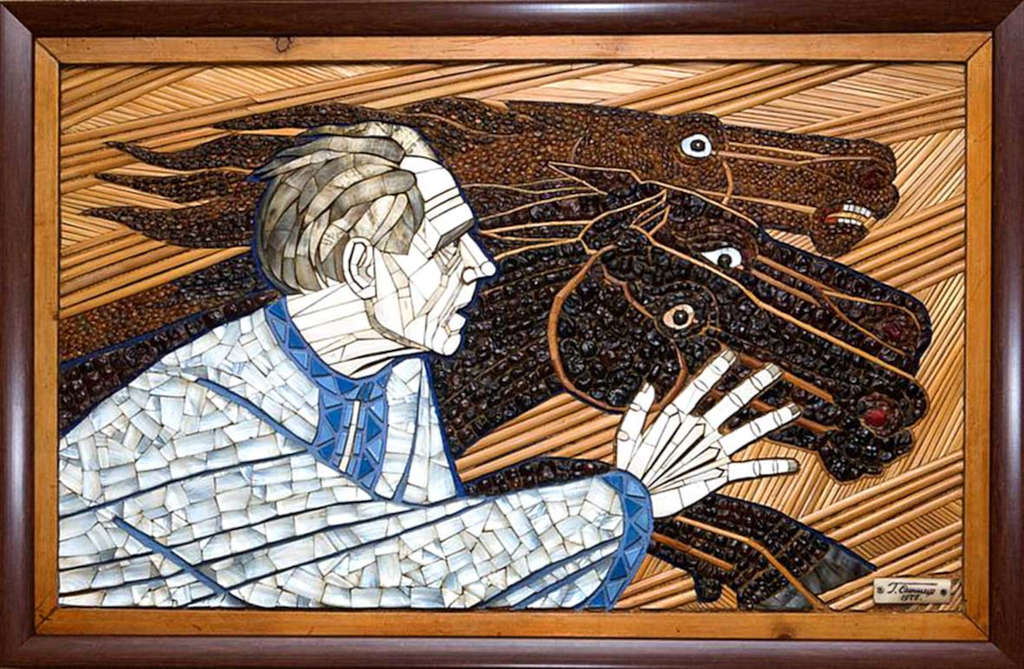 In the photo: Stop, years. 1976
The painting Babyn Yar appears almost divided into two contrasting worlds. Its lower half is dominated by the crimson depths of the ravine, while only dark green vegetation clings to the surrounding hills. Not a single living soul is visible. In the distance, beyond thick black clouds of smoke, stands the white-stone city of Kyiv. Across the horizon, black and blue plumes of smoke rise from countless fires. Symbolic yet hauntingly vivid, the artist’s depiction of this tragic chapter in history resonates powerfully with the present day: bomb craters, deserted cities emptied of people, and skies illuminated by the glow of destruction.
Remembering. The closing months of last year—November and December—were especially rich in cultural events in Kyiv. The Taras Shevchenko National Museum hosted an exhibition marking the 100th anniversary of Viktor Zaretskyi. Among the highlights was the recollection of the creative collaboration led by Hryhorii Synytsia on the mosaics of Alla Horska and Viktor Zaretskyi at a school in Donetsk. In the years that followed, both artists further developed their mentor's ideas, helping to establish a new national school of colour in Ukrainian monumental art.
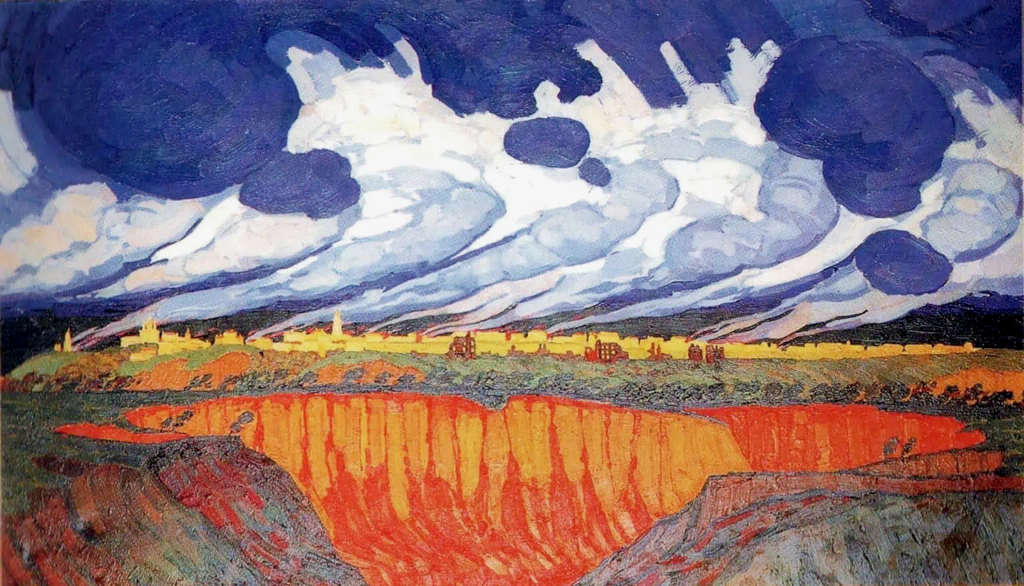 На фото: Бабин Яр, 1961 р.
At Mystetskyi Arsenal, the exhibition As Long as We Are Here, Everything Will Be Fine, dedicated to Vasyl Stus, featured photographs documenting the poet's meetings with the Sixtiers movement, including Hryhorii Synytsia, in Donetsk and Mariupol in 1966–1967. It was during this period that Stus's civic convictions took shape, founded on the belief that every individual bears personal responsibility "before the land, before the people, before history."
The National Museum of Literature of Ukraine presented the exhibition In the Shimmer of the Dearest Faces, introducing visitors to Vasyl Stus's closest circle. The exhibition explored the people who shaped his life—his family and the close-knit community of the Sixtiers, including Hryhorii Synytsia, whom Stus met in 1963 before emerging as one of the leading figures of the Ukrainian resistance movement of the 1960s–1980s.
Meanwhile, the Museum of the Sixtiers unveiled a small exhibition dedicated to the 65th anniversary of the opening of the first section of the Kyiv Metro. The project explored how the metro became intertwined with the lives and creative work of many talented representatives of the Sixtiers generation.
Above All. In the later years of his life, when recognition and acclaim finally came to him, museums repeatedly offered to purchase Hryhorii Synytsia's works. Instead, the artist chose to donate his entire artistic legacy—more than 500 paintings, large-format watercolours, and floral mosaic compositions—to the Ukrainian people. In a letter to the President of Ukraine, he wrote: "By presenting this gift to my people, I wish once again to remind them that our lives and our happiness must, above all, be defined by spirituality and love, and that Ukraine's interests must come before everything else." Today, the legacy of this outstanding monumental artist is preserved in the collections of the Directorate of Art Exhibitions of Ukraine, the Kryvyi Rih Local History Museum, and numerous museums across Ukraine—including the Hryhorii Synytsia Art Gallery at Igor Sikorsky Kyiv Polytechnic Institute. Let us remember. Let us cherish. Let us prove worthy of this legacy.
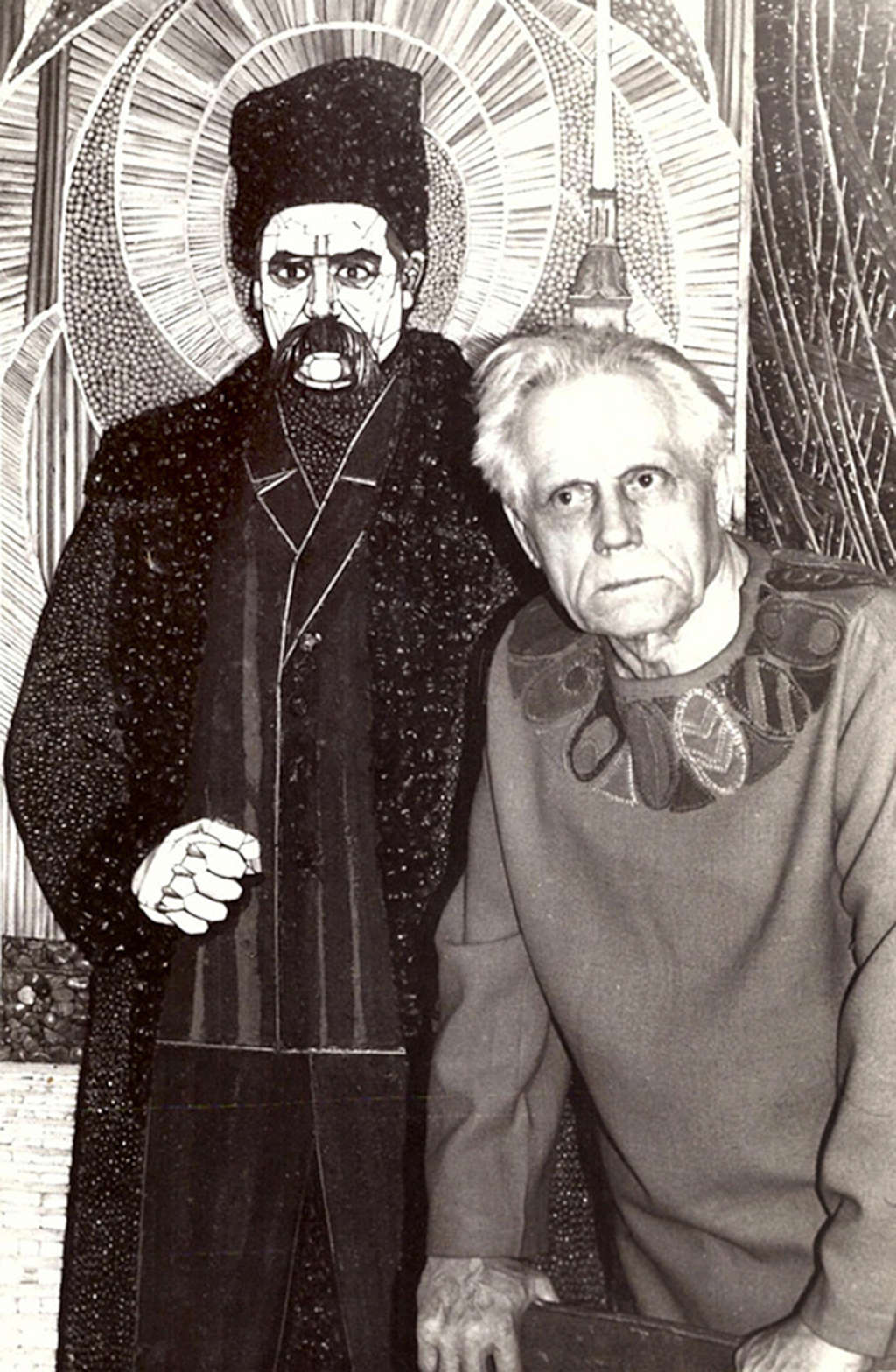 In the photo: H.I. Sinitsa