

The Department of Biosafety and Human Health of the Faculty of Biomedical Engineering at Igor Sikorsky Kyiv Polytechnic Institute is actively expanding international cooperation in the fields of rehabilitation, occupational therapy, and advanced biomedical engineering technologies. Such partnerships have become particularly important in the context of developing Ukraine's rehabilitation system and introducing modern international practices, especially in the field of occupational therapy.
Occupational therapy is now one of the key areas of rehabilitation, as its primary goal is to help individuals regain the highest possible level of independence, activity, and quality of life after injuries, illnesses, or the loss of physical or cognitive functions. In the context of the prolonged war, an increasing number of military personnel and civilians require rehabilitation services, making the implementation of occupational therapy in Ukraine especially important.
It is worth noting that the systematic development of occupational therapy in Ukraine began in 2015, while the profession and academic discipline started to take shape between 2016 and 2018. In contrast, occupational therapy has a much longer history in many European countries, particularly in Sweden, where the national occupational therapy system has been operating officially since 1947. The Swedish model is distinguished by its continuous development, a high level of interdisciplinary collaboration with clinical practice and physical therapy, and its close integration into the country's healthcare system.
One of the Department of Biosafety and Human Health's most significant international initiatives to date has been its participation in the project "Occupational Therapy Without Borders: Swedish–Ukrainian Professional Exchange for the Sustainable Development of Rehabilitation in Ukraine (CURIOUS)." The project brings together Ukrainian and Swedish specialists to exchange expertise, strengthen professional collaboration, and introduce modern approaches to occupational therapy and rehabilitation into Ukrainian practice. As part of the project, a Ukrainian delegation took part in a professional study visit to Stockholm, Sweden, in April, with the support of the Swedish organization Beredskapslyftet. The delegation included representatives of the Department of Biosafety and Human Health: Acting Head of the Department Ihor Khudetskyi, Professor Oleksandr Hloba, Associate Professor Yuliia Antonova-Rafi, Senior Lecturer Hanna Melnyk, and Assistant Lecturers Alina Lytvynchuk, Daryna Danko, and Hanna Kykhnei.
The primary objective of the study visit was to explore the advanced practices of Swedish institutions in the fields of occupational therapy, rehabilitation, and inclusive education, while strengthening cooperation between the Ukrainian, Swedish, and broader European professional communities. During the visit, the department's representatives gained valuable international experience and became familiar with contemporary occupational therapy practices.
The program combined both theoretical and practical components and included professional visits to Aleris Rehab Station Stockholm AB, the Department of Rehabilitation Medicine at Danderyd Hospital, Stockholms Sjukhem Rehabilitation Center, Sophiahemmet Hospital, Karolinska Institutet—one of Europe's leading medical universities—the Swedish Association of Occupational Therapists, and the Independent Living Institute in Stockholm.
One of the most impressive aspects of the visit for the participants was the Swedish approach to interdisciplinary rehabilitation, in which the occupational therapist plays a central role alongside physicians, physical therapists, psychologists, and social workers. The Ukrainian delegation also became acquainted with internationally recognized models for assessing patients' functional status, particularly the Model of Human Occupation (MOHO) and the MOHOST assessment tool, both of which are widely used in Swedish clinical practice.
For the representatives of Igor Sikorsky Kyiv Polytechnic Institute, the visit was not only a valuable professional training opportunity but also a chance to observe how the principles of inclusiveness, accessibility, and person-centered care are implemented in Swedish rehabilitation and occupational therapy. They also explored adaptive learning environments, spaces designed for individual and collaborative work, digital technologies supporting patient care, barrier-free infrastructure, and personalized rehabilitation approaches. Above all, the delegation highlighted the high level of cooperation among educational institutions, healthcare providers, and government agencies, as well as the strong state support for the occupational therapy profession.
Overall, the experience gained during the visit will have a direct impact on the further development of the educational programs at Igor Sikorsky Kyiv Polytechnic Institute. Based on the outcomes of the training, the university plans to introduce new approaches to educating students in the Physical Therapy and Occupational Therapy program, with a particular focus on rehabilitation technologies, occupational therapy, and inclusive education. These initiatives will also be supported by the new Educational and Research Laboratory of Prosthetics, Medical Rehabilitation, and Occupational Therapy at the Faculty of Biomedical Engineering, where international expertise, scientific research, and hands-on student training are brought together. Future plans also include joint research projects, student and faculty exchanges, the development of new educational components, and the implementation of European occupational therapy practices in Ukraine.
As a result of the visit, preliminary agreements were reached to continue scientific and professional cooperation with Swedish partners, establish joint working groups, and expand international programs in occupational therapy and rehabilitation. The Department of Biosafety and Human Health's participation in the CURIOUS project has reaffirmed the importance of integrating Ukrainian education, research, and rehabilitation practice into the international professional community.
Today, one of the department's key priorities is adapting Swedish experience to the Ukrainian context. The knowledge, modern methodologies, and practical expertise gained through international cooperation are planned to be integrated into the educational process, research activities, and the practical training of future occupational therapists and rehabilitation specialists. These efforts will contribute to the development of a modern rehabilitation system in Ukraine based on international standards, evidence-based practices, and interdisciplinary collaboration.
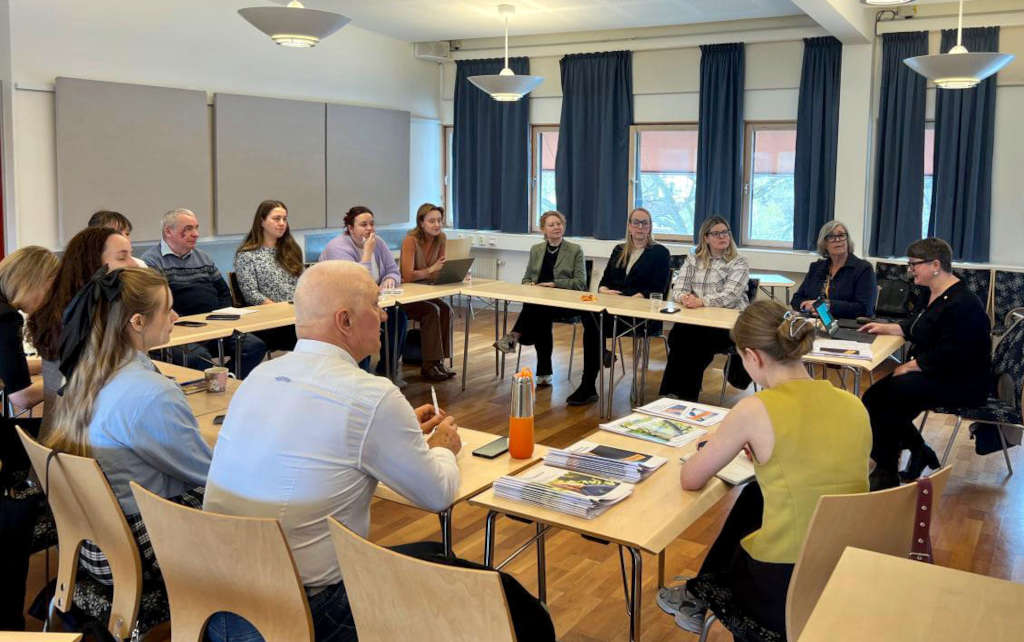 In the photo: A delegation from the KPI in a meeting with the Swedish Association of Occupational Therapists