
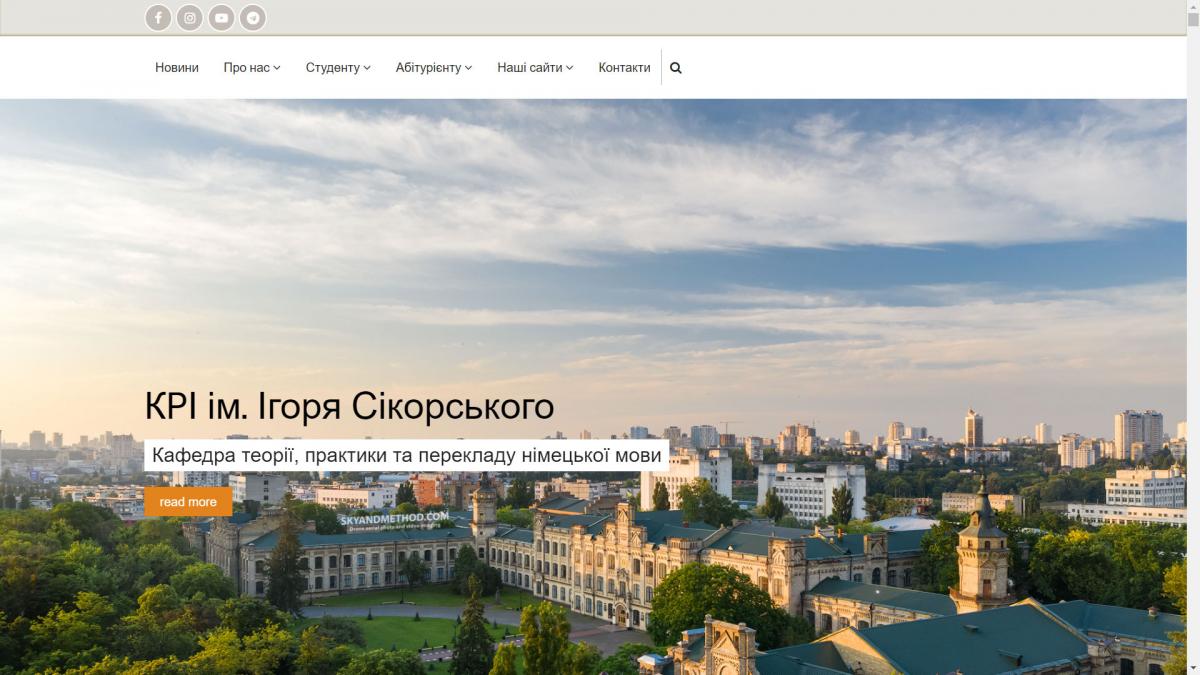
Department of Theory, Practice and Translation of German (KTPPNM), Faculty of Linguistics, National Technical University of Ukraine "Igor Sikorsky Kyiv Polytechnic Institute"Telephone: +38 044 204 83 11,
E-mail: kafedra2009@ukr.net
Website: https://ktppnm.kpi.ua

The Department of German Language Theory, Practice, and Translation was established in 2000 following the reorganization of the Department of Foreign Languages No. 2 within the Faculty of Linguistics.
The former head of the department—Associate Professor, Candidate of Philological Sciences, and Professor of the Department of TPPNM, Helena Ludwiga Lysenko—assembled a team of highly qualified staff—professors, associate professors, and senior lecturers—who conscientiously fulfill their professional duties. From March 2021 to August 2025, the duties of the department head were performed by Olena Anatoliivna Lazebna, Candidate of Philological Sciences and Associate Professor of the department.
Since September 2025, the acting head of the department has been Svitlana Maryanivna Ivanenko, Doctor of Philological Sciences and Professor. The department’s academic and teaching staff actively participate in the educational and scientific life of Ukraine and Germany, work on international programs, take part in international scientific and pedagogical seminars and conferences, enhance their professional and pedagogical qualifications, and undergo internships in European countries and at leading universities in Ukraine.
Today, the department’s development concept is directly linked to the reform of the education system.
The department’s priorities include the implementation of multimedia teaching technologies, strengthening the department’s scientific potential by involving young specialists in research, improving teaching methods, and implementing necessary changes in accordance with current regulations and requirements of the Ministry of Education and Science.
At the Department of Theory, Practice, and Translation of the German Language, students study under specializations 035 and B11 (Philology) across three educational programs: the first (bachelor’s) level of higher education, the second (master’s) level of higher education, and the third (PhD) level of higher education in the specialization 035.043 “Germanic Languages and Literatures (including translation), first language—German.” The objectives and learning outcomes of the educational programs enable graduates to be fluent in two foreign languages—German and English—to solve complex specialized tasks in translation, to facilitate and ensure intercultural professional interaction among members of the scientific and technical community, to conduct research in the fields of philology and translation, and more. In 2020, the department successfully completed the accreditation of two educational programs (at the bachelor’s and master’s levels).
Graduates of the Department of Theory, Practice, and Translation of the German Language are highly qualified specialists who perform their professional duties at a highly competitive level in various domestic and international organizations:
Ukrainian branches of German companies, the Goethe-Institut in Ukraine, travel and advertising agencies, language schools, translation agencies, and many other prestigious organizations. A significant number of graduates continue their studies in Germany and Austria and work at foreign firms and companies. To facilitate the employment of its graduates, the Department of German Language Theory, Practice, and Translation enters into cooperation agreements with reputable domestic organizations and engages stakeholders in collaboration.
The Department of German Language Theory, Practice, and Translation has established contacts with international partners to involve them in both the educational process and subsequent employment. As part of the collaboration with the German Academic Exchange Service (DAAD), there is a regular practice of inviting native German speakers and lecturers from the organization to participate in classroom sessions. Currently, the department employs lecturer Konstanze Otterbach, with whom a five-year agreement has been signed. Seminars, master classes, workshops, and professional development courses are regularly organized for students and faculty members to optimize and modernize the educational process. Students and faculty members are regularly given the opportunity to participate in the “Erasmus+” program as part of academic mobility initiatives.
Students in the department study using the latest communicative methodologies from publishers such as Hueber, Klett, Langenscheidt, and Schubert.
Our students demonstrate high achievements through active participation in international scientific and practical conferences, win prizes in translation competitions and academic contests, and regularly receive grants and scholarships from international organizations; they are also socially active and engaged participants in the student life of our university.