

Meetings with diplomatic representatives from successful countries are always of interest to KPI students and faculty. This is especially true for countries that are recognized leaders in technological development. So, when Park Ki-chang, the Ambassador Extraordinary and Plenipotentiary of the Republic of Korea to Ukraine, delivered his lecture at the Smart Shelter of the Scientific and Technical Library on March 27, Kyiv Polytechnic Institute students listened with rapt attention. And no wonder: his presentation on the topic "Korea-Ukraine Partnership: Technology, Innovation and a Future We Build Together" was dedicated to the partnership between one of the world’s most advanced high-tech nations and Ukraine in fields that are today arguably decisive in ensuring the economic development of civilized countries.
In his welcoming remarks to the guest, Rector Anatolii Melnychenko spoke about how important such a partnership is for Ukraine as a whole and for our university in particular: “The Republic of Korea is a global leader in technology and investment, digital transformation, and innovative development. For our university, a community striving for excellence in engineering, scientific discoveries, and international cooperation, this dialogue is particularly valuable. We believe that a strong academic and technological partnership between Ukraine and the Republic of Korea will not only contribute to the renewal of our country’s modernization but also open new horizons for joint research, student mobility, and projects that foster innovation.”
It is worth noting that Park Ki-chang spoke not only about potential areas of cooperation between Ukraine and the Republic of Korea. A significant portion of his lecture focused on South Korea’s revival following its near-total destruction during the 1950–1953 war with totalitarian North Korea. In particular, he discussed how the country’s choice of development path led to its transformation into one of the most economically developed and successful nations in the modern world. This experience is extremely important for Ukraine. In fact, the ambassador began by tracing the origins of this success story: “Seventy years ago, Korea was a completely different country. After the Korean War in 1953, most of Korea’s industrial base was destroyed—completely destroyed. Per capita income was less than $100 a year. Korea was one of the poorest countries in the world…". At the same time, the country had very limited natural and material resources. Its emergence from that abyss, he said, was made possible by a truly strategic government decision—a decision that changed its future. “The country decided to place education, science, and technology at the center of national development. The Korean government made significant investments in engineering universities and research institutes.
It trained a large number of scientists and engineers,” emphasized the Ambassador of the Republic of Korea. “Thus, Korea’s economic growth was not merely industrial reconstruction. It was the result of the combined efforts of science, technology, and industrial policy.”
This transition from poverty to economic prosperity, as Park Ki-chang explained, had three stages.
The first of these is the period that can be called the “era of industrial technologies” of the 1970s and 1980s, when South Korea focused on developing the steel, shipbuilding, and automotive industries. Engineering, education, and manufacturing capacity were key for the country. At that time, according to the ambassador, thousands of young engineers learned technology directly in factories and shipyards. It was they, in his view, who became the builders of modern Korean industry.
The second was the digital revolution. It was a response to the economic shock South Korea experienced due to the 1997 global financial and economic crisis, which severely impacted the Korean economy. However, the state turned this crisis into opportunities for innovation. “The government implemented large-scale reforms, including financial system reform, corporate restructuring, strengthening industrial competitiveness, and most importantly—significant investments in the IT industry,” said the ambassador. “The restructuring efforts were difficult, but they strengthened Korea’s industrial competitiveness.” Significant investments went into IT infrastructure. And it was the IT sector that became the new engine of economic growth. “This experience teaches us an important lesson. A crisis can weaken a country, but with the right choices, it can also make it stronger,” the Ambassador of the Republic of Korea is convinced.
And the third stage was defined by the era of advanced convergent industries (i.e., those sectors of the economy and science that merge as a result of the interpenetration of technologies, leading to the creation of new products, services, and even entire industries – author’s note), which began in the 2010s.
“The Korean economic miracle is not just an ordinary story of economic growth,” asserts Park Ki-chang. "It is based on three key elements. First, investment in education, science, and technology. Second, the role of engineers and scientists. Third, a national strategy that demonstrates innovation even during a crisis."
At the same time, he did not shy away from the problems his country has faced in recent years: an extremely low birth rate; rising economic inequality; rapid technological changes driven by the ever-wider penetration of artificial intelligence into all spheres of human activity; and a forced industrial revolution. All of this and much more is ultimately transforming society at a rapid pace. Therefore, in his view, Korea’s development is not merely a success story. It is also a continuous process of overcoming challenges.
We did not dwell in such detail on the stages South Korea has gone through in its development over the past seventy years merely for the sake of general development: the key conditions for success at each stage were the state’s heightened focus on building national knowledge-intensive sectors of the economy and introducing technologies new for the respective period, as well as ensuring these processes were supported by the necessary personnel. Thus, the idea of the role of quality education in the country’s revival ran like a thread through the entire lecture. After all, without educated specialists, it is impossible to achieve success in fields that require not physical strength, endurance, and skills honed once and for all in specific sectors, but rather in-depth knowledge and the ability to solve non-trivial problems and overcome non-standard challenges.
The experience shared by the South Korean ambassador with the audience could be very useful for Ukraine. Especially given the certain similarity between the situation South Korea faced in the middle of the last century and the one Ukraine is painfully experiencing today, as well as considering the enormous amount of work that awaits us after the war ends. Work in which modern technologies will play a decisive role and which will be aimed not so much at rebuilding the old industrial structure as at creating new knowledge-intensive and high-tech sectors. This, incidentally, will also necessitate constant attention from the state toward the development of technical and research universities, scientific disciplines, and cutting-edge industrial sectors at the forefront of technological progress—primarily those very technologies such as artificial intelligence, microelectronics, biotechnology, and so on. This new era, in the ambassador’s view, opens up promising avenues for cooperation between Ukraine and Korea in the fields of science and innovation, digital transformation and artificial intelligence, energy, smart cities, e-governance, and, once again, education and talent development across all sectors, and not necessarily limited to the natural sciences and engineering.
The latter is very important, as the two nations can be brought closer together not only through cooperation in science, technology, and innovation, but also through cultural and academic exchanges, which can spread knowledge about one another among the representatives of these nations and, as a result, strengthen mutual understanding, empathy, and solid mutual trust. At the same time, cultural exchanges must flow in both directions, not just from Korea to Ukraine. “We should also introduce Korea to Ukrainian music, art, cinema, and literature,” noted the Ambassador Extraordinary and Plenipotentiary of the Republic of Korea. In this context, he proposed the idea of establishing a Ukrainian-Korean Center at Igor Sikorsky Kyiv Polytechnic Institute.
“As the Ambassador of the Republic of Korea to Ukraine, I will make every effort to promote bilateral relations, peace in the region, and prosperity. We will grow together in solidarity with Ukraine!” he assured in conclusion.
This was followed by a discussion with students and faculty who had gathered that day at the NTB Smart Shelter. The audience’s questions were quite varied: whether the Ambassador of the Republic of Korea sees Ukraine as a potential future technological hub of Europe; what priorities in the partnership between Korea and Ukraine should be key over the next five years; whether the Republic of Korea uses digital diplomacy—that is, promoting its national interests, enhancing its influence, and shaping a positive national image through digital technologies, including social media in public diplomacy—and others.
In response to the first question, Park Ki-chang said he is convinced that Ukraine has significant potential to assume the role of a technological leader in Europe, especially after its accession to the European Union. This potential lies primarily in its people: scientists, engineers, and entrepreneurs working in virtually every sector of our country’s economy.
As for the priorities in cooperation between the country he represents and Ukraine, he identified three main areas: the first is the restoration and development of infrastructure, since during the full-scale invasion, much of Ukraine’s housing stock and road, transport, and energy infrastructure was damaged and destroyed; the second is the implementation of digital transformation, particularly in the fields of artificial intelligence and the Fourth Industrial Revolution; and the third is the education and science sectors, including the development of academic mobility.
Well, the answer to the question about digital diplomacy served as a logical conclusion to this Q&A session. The Ambassador of the Republic of Korea noted that, unlike during the Cold War, modern public diplomacy concerns everyone, including governments, companies, nations, and all people of the world. He added that thanks to the openness of its policies, Ukraine has become one of the world’s leading nations in the use of such diplomatic tools, and South Korea is following the same path.
“Modern diplomacy is not just what diplomats and government officials do!” he emphasized. “It is something in which everyone can participate—from businesspeople to ordinary citizens.”
After the meeting with the Polytechnic community, Park Ki-chang discussed with university leadership the further deepening of cooperation with Korean universities and companies in the fields of IT, energy, and others, as well as the opening of the Ukrainian-Korean Center at KPI as a platform for academic interaction and cultural exchange.
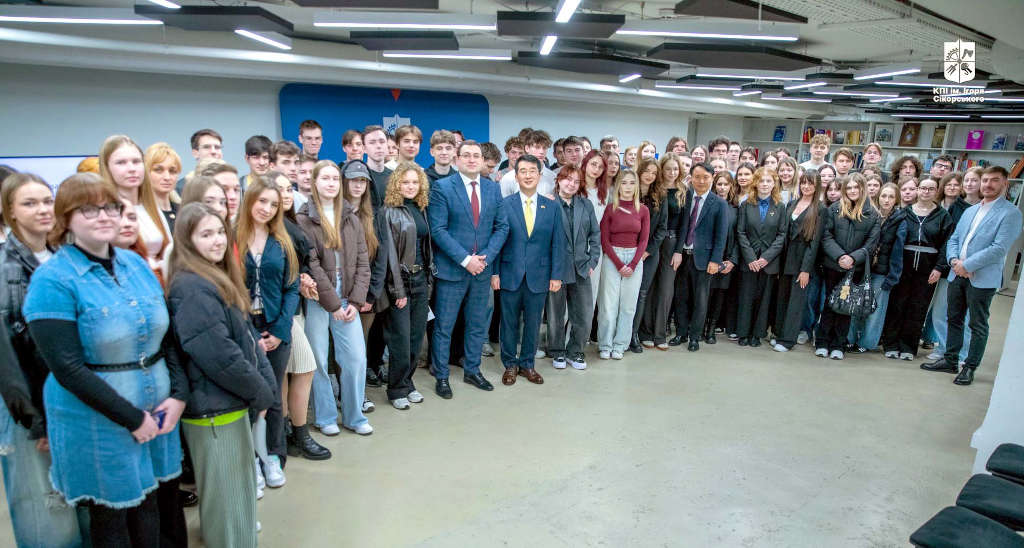 In the photo: a joint photo with Park Ki-chang
🇰🇷 Students, faculty, and university administrators engaged in a Q&A session with Park Ki-chang, Ambassador Extraordinary and Plenipotentiary of the Republic of Korea, during an open lecture.
📋 The lecture, titled “Korea–Ukraine Partnership: Technology, Innovation, and a Future We Build Together,” discussed South Korea’s experience as one of the world’s most technologically advanced countries and practices that could be useful for Ukraine:
🔹 scientific and technological transformation as the foundation for national development;
🔹 the role of engineers, innovators, technologies, innovations, and reforms in post-war reconstruction and during periods of crisis;
🔹 the development of technical and research universities, as well as a STEM culture, as the foundation of a high-tech state;
🔹 the development of industrial technologies and cutting-edge industries—from memory chips and artificial intelligence to batteries for electric vehicles and biotechnology.
🤝 A working meeting was also held between Mr. Park Ki-chang and the KPI administration, during which they discussed strengthening cooperation with Korean universities and companies in the fields of IT, energy—particularly small modular reactors—and fundamental research.
Special attention was paid to cultural and institutional initiatives, such as the creation of a Ukrainian-Korean Center at KPI—a platform for academic interaction and cultural exchange between the countries.